





CLARITY
Following Carat Weight, we learn about Clarity. The less inclusions a diamond has, the more expensive it will be. Clarity refers to the possible existence of internal and external inclusions of a diamond. This identifies the inclusion characteristics within and on the diamond.
GIA’s scale of clarity grading is represented as
- No imperfections - FL or IF
(Flawless - no blemishes or internal inclusions under 10x magnification)
(Internally Flawless meaning no internal inclusions under 10x magnification)
- Minute imperfections -VVS (VVS1, VVS2)
(VVS1 - extremely difficult to see inclusions under 10x magnification)
(VVS2 - very difficult to see inclusions under 10x magnification)
- Minor imperfections - VS (VS1, VS2)
(VS1 - difficult to see inclusions under 10x magnification)
(VS2 - somewhat easy to see inclusions under 10x magnification)
- Noticeable imperfections - SI (SI1, SI2)
(SI1 - easy to see inclusions under 10x magnification)
(SI2 - very easy to see inclusions under 10x magnification)
- Obvious imperfections -I (I1, I2, I3)
(I1, I2, I3 – inclusions are obvious under 10x magnification and affects the diamond’s durability, brilliance and overall appearance.)
(Some diamond labs use the term "Pique" or pronounced as “PeeKay” using the abbreviations P1, P2, and P3, rather
than I1, I2, and I3.)
AGS’s scale of clarity grading is represented as
- AGS 0 = GIA FL and IF
- AGS 1 and 2 = GIA VVS1 and VVS2
- AGS 3 and 4 = GIA VS1 and VS2
- AGS 5 and 6 = GIA SI1 and SI2
- AGS 7,8,9,10 = GIA I1, I2, and I3
Clarity Characteristics can be Internal inclusions or external inclusions. The Size of the Inclusion, Quantity of Inclusions, Type of the Inclusion, Color/Relief(reflectivity), and the Placement of the Inclusion, determine the Clarity Grade. While diamonds with High Clarity are always in demand as they stand for purity to most, diamonds with Medium Clarity (VVS1 to VS2) can be as great as Flawless diamonds as no one can see the difference.
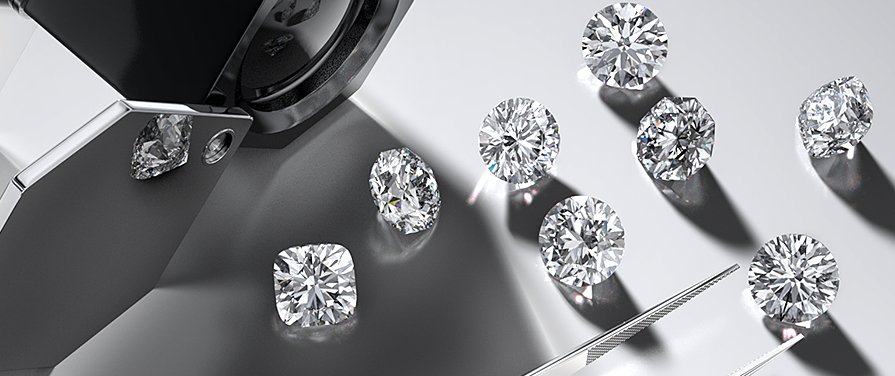
You should use both Darkfield Illumination and Overhead Lighting when viewing diamonds. The Darkfield Illumination is very important when determining a diamond’s clarity grade. This is a microscope that takes pictures of diamonds when it is placed under high intensity light with the diamond sitting on a black base. This light focuses on the pavilion facets, and reveals the inclusions of the interior on the diamond. When using the Darkfield Illumination microscope, the inclusions are clearly shown due to high intensity light, but this is not how the diamond will look in just Overhead Lighting.
A diamond is Eye-Clean when its inclusions cannot be seen in a ‘face up’ position and viewed 6-12 inches away from the eye. It is possible to see imperfections with the naked eye on a lower clarity grade such as SI when turned face down. Note that this view can innaccurately represent the diamond’s clarity.
FL-VS2 (FL being Flawless, VS2 being somewhat easily noticeable) are considered the ideal clarity. Coming after FL, VVS diamonds are next in the clarity grading scale. VVS stands for very very small inclusions. These are the second-best grade but it is difficult to distinguish them from Flawless diamonds without an expert’s assessment on their inclusions. Some VVS inclusions include, small internal or external spots, a small crystal, a slightly rough facet edge, or one or two slightly larger cut faces. However, since Flawless diamonds are almost impossible to come across, VVS diamond’s in clarity hold the most high value. If you do have trouble choosing between a Flawless and a VVS diamond in clarity, just know that the cost is a big difference, and anyone that is seeking a high end diamond will usually take VVS diamonds for this reason. Following VVS diamond’s are VS diamonds. If you are financially looking for a more practical diamond, these are still considered one of the best diamonds, because even though you can see more inclusions than FL or VVS diamonds, they are less costly, and still outstanding diamonds!
From SI and there on, are known as the grades when you can spot out the inclusions with your naked eye. ‘I’ standing for Imperfect or Pique, means you can see inclusions on the diamond within 35cm without previously being informed where the inclusions are. VS1 and SI2 diamonds in Clarity are very different in quality, but they make look extremely identical to the naked eye, which is why it is important to have accurate and expert assessment of a diamond’s clarity.
Clarity Grades
-
FL (Flawless): No internal or external inclusions. There isn’t much to say about these except they are very rare and they are priced at IF cost.
-
IF (Internally Flawless): No internal inclusions, but may have small, very unnoticeable external inclusions.
-
VVS1 (Extremely Difficult): Very very slightly imperfect diamonds. They have very small inclusions which are extremely difficult to see. They can only be seen under 10x magnification, and even then, the inclusions are hard to spot! These inclusions are so small, they can be mistaken for little specks of dust or something irrelevant to the diamond at all! If the inclusions are a bothersome, they can be removed by a little re-polishing.
-
VVS2 (Very Difficult): Experts can locate these under a 10x magnification. The inclusions are still very small, with maybe a few more minute flaws than VVS1, but it does not make VVS2 any less valuable than a VVS1 diamond.
-
VS1 (Difficult): Very small inclusions, they have more small or large inclusions than VVS diamonds. These inclusions are still minor, and are usually not visible to the naked eye. Only skilled graders can locate them under 10x magnification.
-
VS2 (Somewhat easy): Still very small inclusions but with more flaws than VS1 diamonds. This clarity grade is known as the cutoff grade for most buyers. Only a skilled grader can locate them under 10x magnification.
-
SI1 (Easy): This clarity grade is still popular because it’s an eye clean diamond, and the price difference between a SI and a VS is huge! Buyers on a budge are more concerned about the price difference as they want a good price for a good looking diamond. The SI grade has easy to see inclusions under a 10x magnification and sometimes with the naked eye.
-
SI2 (Very Easy): The inclusions in this grade get more noticeable to the naked eye, and under 10x magnification.
*SI3 Before the early 1990’s, SI3 was non existent. As these diamonds contain more flaws than the SI2 had, it was graded as “I” for Imperfect! The SI3 grade was made a grade for the reason that there are diamonds that have more inclusions than SI2 but not noticeable enough to be graded as Imperfect. SI3 is the grade that separates an easy to spot inclusion diamond from a diamond being considered Imperfect. However, the GIA and AGS still do not consider there being an SI3, they only use SI2 and I1.
-
I1 to I3 (Imperfect): Diamonds with obvious inclusions in and on the stone are placed in this grade. They are both easy to see with the naked eye and jump out at you in the microscope. An eye visible feather, or crystal are common.
*I1 is different from I2 and I3. I3 has inclusions, but these inclusions do not affect the diamond’s overall brilliance if the diamond has a good cut grade. While this grade being classified is the lowest on the grading scale, this grade is the most common on price reports and people still buy them. If the inclusions are on the edges of the diamond, you can get prongs to cover up the blemishes on the diamond. However, severe inclusions on the edges can be a very bad thing. -
*I2 and I3 - These clarity grades containing large inclusions can diminish the diamond’s brilliance and affect its durability, hence why if you buy a diamond with inclusions on the edges of it, and use prongs to hide them, it can be a bad thing.
Internal Inclusions
Feather - This fissure is located within the diamond and can place a durability risk depending on how big it is and where it is located. These inclusions can be found from VVS’s to I’s. Usually if the feather is not on the girdle’s edge, does not connect to more feathers near the surface, or create an opening on the surface of the stone, it is not a durability risk. Feather inclusions can appear reflective, colored, white, or transparent.
*There are two types of feathers; straight and curvy. The straight feather( sometimes referred to ‘needle’) usually follows a cleavage plane. If the straight feather is glistening, or shining, it means that the feather has parted the diamond wide enough to let in air. Two feathers that are breaking the girdle at the interior of the diamond are a huge risk.
*Watch out for some enhanced diamonds, for they might have dangerous feathers that are hidden. Unless you know what has been done to the enhanced diamond, stay away from them. You can locate feathers by reading the clarity plot if you have a lab report. Thoroughly examine the diamond with a loupe from all angles to find feathers if your stone is not certified.
Pinpoint - Very small crystal, and it’s close to white in color. These inclusions can be found in any grade. The pinpoint is usually the inclusion that separates the VVS’s from IF grade.
Crystal - Mineral deposit found, either alone or in groups, in the inside of the diamond. It can be colored, or colorless but usually appears black in overhead lighting. Some diamonds may have large crystals that can be seen with the naked eye, and can affect the diamond’s clarity. Sometimes these crystals can resemble a diamond inside of the diamond.
Needle - An elongated inclusion. It is very similar to a feather, but it has no radiating lines. Needle inclusion is only visible to the naked eye if it has color or is very fine. Some are even given to the diamond to give it a special look.
Cloud - Known as a group of pinpoints.
Cavity - The surface of the diamond has an opening, as a result of a natural flaw in the rough stone.
Bruise - A chip in the diamond surface that may include root-like feathers radiating into the diamond
Bearding - Lines that occur during the cutting of the diamond.
Cleavage - Straight crack without any feathering
Internal Graining - Crystals that grew with a milky color, following faint lines or streaks, they can or can not be colored.
Knot - Included crystal that touches the surface of a polished diamond.
Laser Lines - Slightly noticeable trails left when lasers are used to remove dark inclusions
External Inclusions (blemishes)
Scratches - Fine lines usually around the surface of a diamond, possibly caused by cutting of the diamond. Deep scratches can be removed by enhancing the diamond. These can be curved or straight.
Fracture - Usually irregular in shape, causing the diamonds to look chipped. Basically, it’s a crack on the surface of the diamond.
Nicks - Diamonds are chipped at places such as the girdle or facet edge causing nicks. Can be fixed by adding more facets, just be warned that adding too many facets, can decrease a diamond’s brilliance.
Pits - Small holes/dots white in color on the surface of the diamond. Usually not noticeable to the naked eye.
Polish lines - Polishing a diamond can cause minute lines during the process.
Chip - A shallow nick in the surface of the diamond created during cutting.
Natural - The original surface of the diamond which has not been polished. This is actually considered a sign of good cutting practice.
Twinning Wisp - This line is noticeable inside the diamond that may look like a ripple. Caused by an irregularity in the diamond’s structure. These are more easily seen in SI clarity grades.
That’s all for Clarity! Just always keep in mind; Do not mistake the girdle’s reflection halfway into the pavilion as an inclusions when viewing from the side. It’s better to see it than it not being there at all. Always look at the diamond under microscope to know its true price. Although the lowest Clarity grades with the most inclusions may become fixated to you, average people who see your diamond may not notice it and instead, compliment on your stone.