




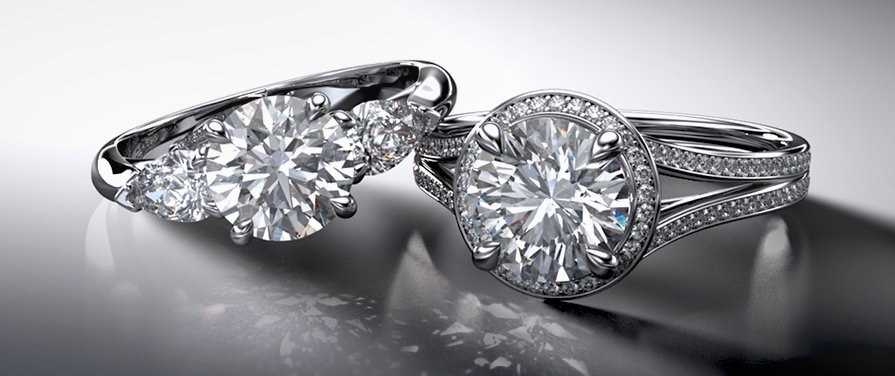
CARAT WEIGHT
First off, let’s start with reading about the basics. Diamonds are weighed in carats. What is Carat? Carat is the unit of measurement of a diamond’s weight. Ct is the abbreviation standing for Carat Weight. Why must we measure diamonds in carats? The Fourth General Conference on Weights and Measures accepted the metric carat (.20gram) as a unit of weight in the early year of 1907.
Metric carat equals 0.20 gram as one carat equals 0.20 gram
Carat Weight is determined in units of carats on a diamond scale. Learning Carat Weight is pretty easy when you know about the points that are involved. Points are most commonly referred to diamonds under one carat. For example:
- 0.10ct equals 10 points or a10pointer
- 0.20ct equals 20points or a 20pointer
- 0.30ct equals 30points or a 30pointer
- 0.40ct equals 40points or a 40pointer
and so on.
Only when the 3rd number is a 9, the diamonds’ weight is rounded up to the next decimal point. So for example;
- 0.995ct is rounded to 0.99ct
- 0.996ct is rounded to 0.99ct
- 0.997ct is rounded to 0.99ct
- 0.998ct is rounded to 0.99ct
- 0.999ct is rounded to 1.00ct
Now, you may hear the words “Magic Numbers” frequently when searching about diamonds. This term is described as diamond sizes that are flat. Why to avoid flat numbers? When a diamond reaches certain flat numbers, its price takes a sudden increase, around 20-30%, from a diamond that is 1 point below it. Eg. A 0.49ct and a 0.50ct. The reason why you find so many flat number carat diamonds in the market is because diamond cutters prefer to sell a diamond of inferior quality and make more money by cutting out a flat carat size diamond as compared to say 0.99ct of a higher quality but lose almost 20% in value. Hence, it is difficult to find well cut diamonds of high carat sizes close to the flat carat sizes. The amount of weight loss is just not worth economically for diamond cutters.
Magic number weights such as 0.50ct, 0.70cr, 1.00ct, etc. are a lot more expensive than premium carat weights such as 0.89ct, 0.99ct and 1.99ct despite a slight different of 0.01ct. This is because the price increases drastically when it reaches the next carat weight pricing bracket. For example, diamonds are priced in different pricing groups, such as 0.50-0.69ct, 0.70-0.89ct, etc. Hence, a 0.69 and a 0.70ct would have a price difference of over a thousand dollars, despite being only a 0.01ct difference, whereas a 0.70 and 0.71ct will only have about a $100 difference as they belong within the same pricing bracket.
There are people in the marketplace who determine diamond prices based on its qualities, supply and demand. These reports are published in the marketplace. These pricing reports are categorized in weight. Some examples of these magic numbers in weight are;
- 0.30ct
- 0.40ct
- 0.50ct
- 0.70ct
- 0.90ct
- 1.00ct
- 1.50ct
after that last carat size, the magic number in weight increases every half carat.
Carat weight CAN affect a diamond’s value. It’s pretty simple. The larger the diamond, the more expensive it’ll be. The quality of a diamond ranges the price per carat of a diamond. Since large diamonds are rarer, the price increases as the carat weight increases.
Have a look at how different carat weights look on a finger.
The diamond’s size is NOT the same as the diamond’s carat weight. It is very possible to find two diamonds of 1.00ct and to have one that looks 25% smaller than the other. This is due to the way that the diamond is being cut. A diamond cut with a shallow depth would make the diamond appear larger in size while a diamond that is cut deeper will appear much smaller in size. In very extreme scenarios, it is possible to find a 1.00ct diamond equal to a size of a 0.40ct diamond.
A good example is the video below, showing the importance of Cut over Carat, where a better Cut diamond can look bigger against another diamond with the same carat weight.